
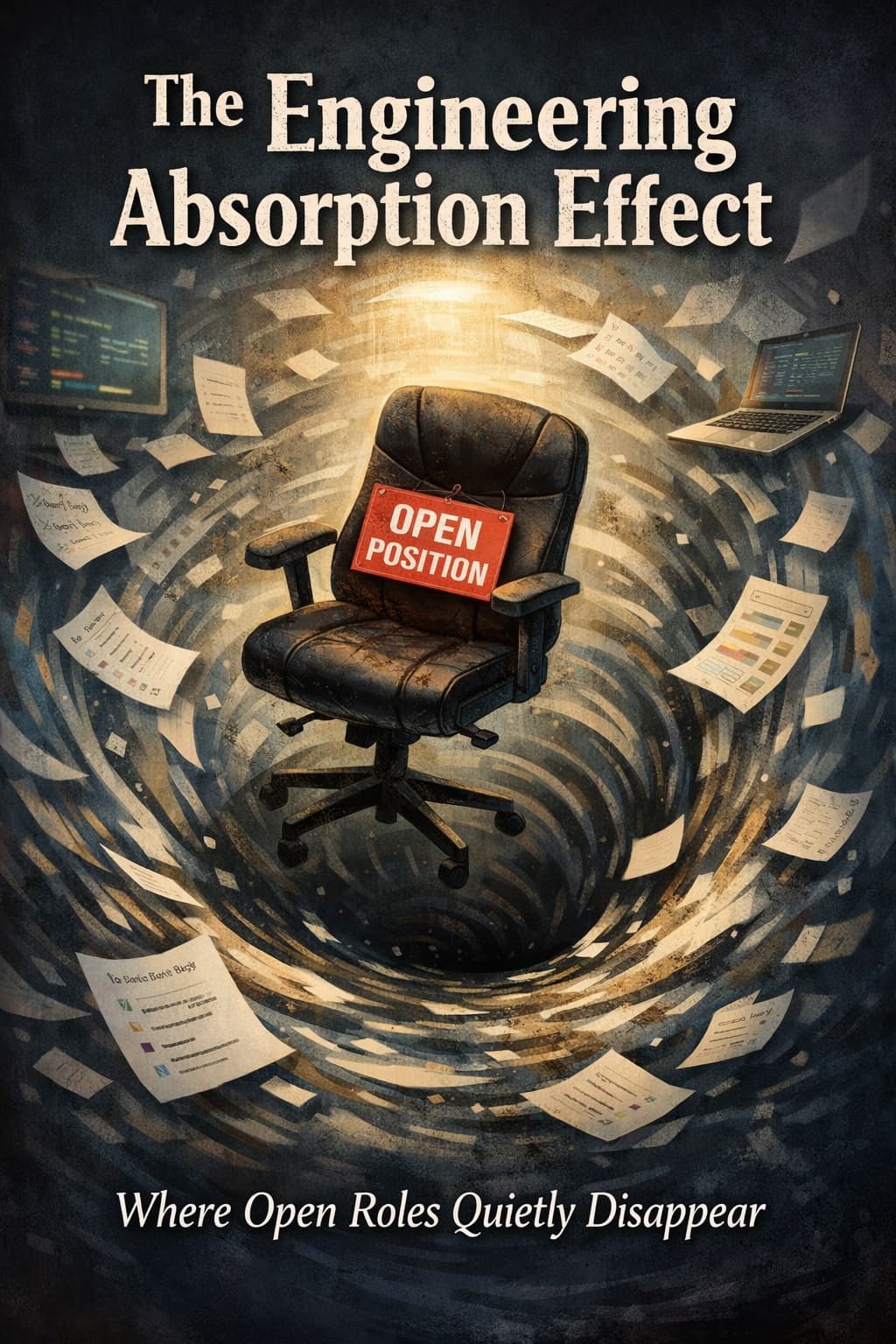
There's a pattern I keep seeing inside fintech and trading technology companies that nobody is naming directly. Engineering headcount gets frozen. A role stays open for three, four, five months. And then quietly, without any announcement, it disappears from the job board.
The team didn't grow. The workload didn't shrink. What happened instead is what I've started calling the Engineering Absorption Effect.
The work got absorbed. By the people already there.
"We just distributed the responsibilities across the existing team. It seemed like the pragmatic call at the time."
What is the Engineering Absorption Effect?
The Engineering Absorption Effect is the slow, invisible process by which open engineering roles are not filled, they are dissolved. The responsibilities attached to that headcount get redistributed across a team that is already at capacity.
It doesn't happen dramatically. It creeps in through 1-to-1s and sprint planning and quiet expectation-setting. Someone picks up extra tickets. A senior engineer starts reviewing more PRs than they should. A product manager starts making architectural decisions they're not qualified to make.
From the outside, it looks like efficiency. The roadmap keeps moving. Releases keep shipping. Costs stay down.
From the inside, it feels like drowning in slow motion.
What I'm hearing in the market
I speak to engineering leaders and senior developers across fintech, market data, and trading technology every week. The conversations have shifted significantly in the past eighteen months.
From engineering managers:
- "We had three open roles going into the budget freeze. We've absorbed all of them. I'm not sure my team can sustain this pace through Q3."
- "The headcount was approved. Then it was paused. Then the role was quietly removed. Nobody told me, I found out when the requisition disappeared from the system."
- "I've stopped asking for headcount because the answer is always no. I just figure out how to get it done with what I have."
From senior developers and engineers:
- "I'm doing the work of two people. I know it. My manager knows it. Nobody is doing anything about it."
- "We hired someone into a junior role when we actually needed a senior. So now I'm doing my job and training them. That wasn't the deal."
- "The velocity metrics still look fine because we're burning ourselves out to keep them that way. It's not sustainable."
Why companies let this happen
The Absorption Effect isn't malicious. It's the result of several well-intentioned decisions compounding on each other.
1. Budget cycles move faster than hiring cycles
A headcount freeze in Q1 can eliminate roles that were 60 days into a search. The hiring team loses momentum. The budget gets reallocated. The role is technically "paused" but practically dead.
2. Short-term metrics mask long-term damage
Velocity, throughput, and release frequency are all lagging indicators. An overworked team can maintain output for two to three quarters before the cracks become visible. By the time the warning signs appear, turnover, missed deadlines, declining code quality, the causal link back to understaffing is hard to make.
3. Engineering leaders absorb the pressure rather than escalate it
The best engineering leaders are problem-solvers by instinct. When headcount is cut, they find a way through. They redistribute. They prioritise. They protect their team where they can. But this same competence makes the problem invisible to the people who control budget.
4. Finance conflates headcount with cost rather than capacity
When a CFO or COO looks at an open req, they see salary plus employer costs. They don't see the cost of the work that role would have done, or the hidden cost of that work being done badly, slowly, or at the expense of someone else's wellbeing.
The real cost of absorption
The Absorption Effect is not free. It has a price. It's just deferred, and when it arrives, it arrives all at once.
- Senior engineers leave. The people most capable of carrying additional load are also the most employable. When they go, they take institutional knowledge that took years to build.
- Technical debt accelerates. Corners get cut. Reviews get rushed. Architecture decisions get made by the wrong people under time pressure.
- Hiring becomes harder. Companies that have burned through good people develop a reputation in the candidate market. Word travels faster than job ads.
- The next hiring cycle costs more. By the time budget is released for engineering headcount again, you're not hiring at the same level. You're hiring to replace people who left and catch up on work that slipped.
What good looks like
The companies I see managing this well share a few characteristics.
They treat headcount as a capacity planning problem, not a cost line. They model the work, what is being done, what isn't being done, and what is being done poorly, and make hiring decisions from that picture.
They distinguish between absorption that is temporary and absorption that is structural. Covering for a team member on leave is expected. Running two engineers below target for two consecutive quarters because finance hasn't signed off is a structural problem that requires escalation, not endurance.
They give engineering leaders the language and the data to push back. It's much harder for finance to ignore a hiring request framed as "we are currently carrying 40% more workload per engineer than our competitors" than one framed as "we need more people."
A final thought
The Engineering Absorption Effect is one of those problems that is entirely visible to the people living it and almost entirely invisible to the people who could solve it. That gap is where good engineering teams break down.
If you're a CTO, CPO, or engineering leader reading this and recognising your team in what I've described, the question to ask is not whether your team can absorb more. They probably can, for now. The question is what it will cost you when they can't.
Richard